Indivisible Chicago Northwest: Year One

Kevin Naglich founded Indivisible Chicago Northwest following the 2024 election, after his wife got tired of his moping. "I don't think I even wanted to talk to anyone for at least a week or so afterward," he says. "Sulking. Just feeling down on myself. My wife finally was just like, well, you can complain about it, or you can try to do something about it."
He began researching organized groups focused on threats to democracy and discovered Indivisible. "It started with this guide a couple of staffers created back in the first Trump term — guidance on how to fight back, how to use the levers of power available to you in Congress. It was inspiring because it was just very logical, very actionable. I thought, OK, maybe there are some things we can do."
Since no chapter existed on the Northwest Side, Kevin set out to start one. He figured he could leverage his background and skills in cyber security, tech sales and online business, and he was at a point financially where he could take a break from working and go all in. Full-time.
"I felt that 30 years from now, if someone asks me what I did when all this happened, there would be no way I could answer that question with 'nothing.' It had to be that I fought and gave it everything I could."
ICNW — Indivisible Chicago Northwest — took a distinctive approach from the start, particularly its focus on community, which allowed it to grow rapidly to nearly 5,000 members. The chapter went light on formal meetings and procedures and concentrated instead on building friendships.
"You're far more likely to take political action if you're able to do it with other people you know," Kevin says. "You're far more likely to go protest if you get to go with two or three friends than if you're just going by yourself. I kind of joked at the beginning that if people confused our chapter with a social club, that would be a good thing."
Even if none of the political stuff we do is effective, there's already been so much positivity in building these community bonds: just seeing other people who have become really good friends that wouldn't necessarily have met each other otherwise. — Kevin
The first ICNW event — a happy hour promoted through neighborhood Facebook groups, Nextdoor, and an Indivisible Chicago Alliance email blast — drew over 300 people to Gracie O'Malley's about a month after the presidential inauguration. It also brought Kevin in touch with some of the individuals who became the core leadership team, including Kristen Vandawalker.
"Right after the election, I thought, that's it," Kristen says. "I'm doing something in the real world this time." An independent consultant specializing in school accountability and nonprofit grant evaluation, she received an Indivisible text and was connected to the Northwest Side chapter. "I don't even think the chapter had a website when I first met Kevin. We had an introductory call about a week before that first event. By the end of the conversation, he asked if I wanted to be the political action director. I hesitated a bit, but he basically walked away from that meeting with me on board."
Jess Jorsch is another key member of the leadership team. Jess had been involved in election work and activism for years with groups like Vote Save America, NextGen America and the Women's March. "I'd heard of Indivisible, and the Northwest Side chapter was hosting one of the first local Chicago events I found outside of the big protests. Kevin reached out after I signed up for a pre-rally event, and the rest is history."
Kevin and the ICNW leadership team intentionally decided to let people contribute based on their own skills and interests rather than feeling like merely a "body" at a protest. Kevin explains it this way. "People would say, 'Hey, I want to get involved. What do you need me to do?' And I would just flip the question back to them. 'What are you interested in doing? What are you good at? What is meaningful to you?'"
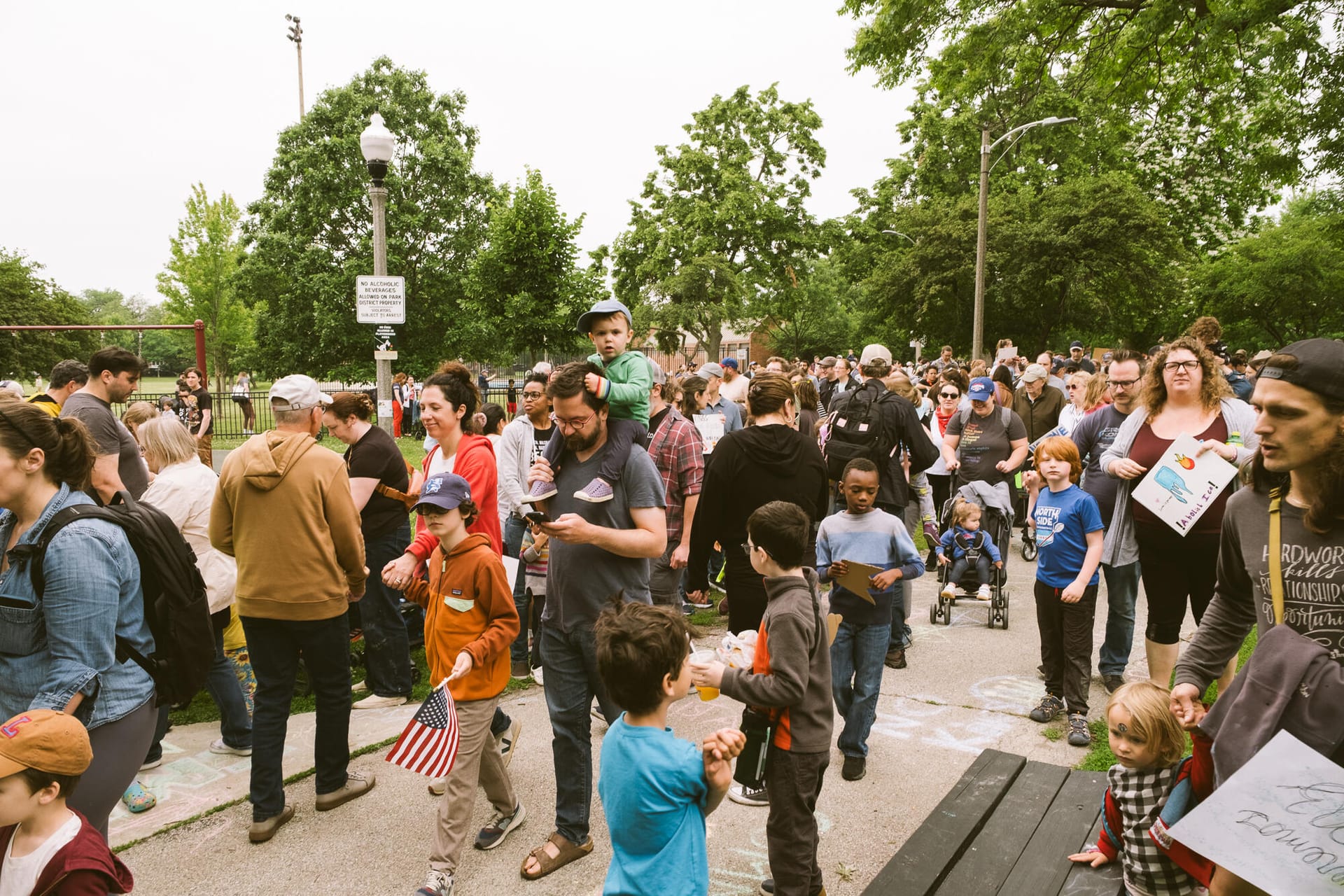
That philosophy gave rise to one of the chapter's most successful initiatives: the parents group. A mom messaged Kevin asking if he'd considered family-focused events. He told her he'd love to have a parent lead this effort. "This was Kate and Alison," Kevin says. "They're the brains behind our Chalk the Walk events. We've had 500-plus people show up to many of these. They're always family-friendly, like puppet making for No Kings. It's a perfect example of someone with a really specific interest creating one of our most successful subgroups."
Amplify, ICNW’s storytelling initiative, followed a similar path. "I knew we needed some form of information-based activism. I didn't know it would turn into Amplify the way it did. That's largely due to Hannah and her vision — telling the stories of real people in our community being impacted, to reach those who maybe weren't thinking of taking action. Because they realize that this is happening here in our neighborhoods.”
The chapter also made a conscious effort to engage younger members through “Zillennial” programming. Started by Kevin's friend Devan, and now run by Audrey, the group has built real momentum. "We just had an event last night," Kevin says, "a happy hour for the under-40 crew — and more than 30 people showed up. It was great energy. People connected to mutual aid groups, election work, postcard-writing and news boosting. There's a lot of excitement to see where it goes."
Geography shapes the chapter's diversity, too. "Our chapter's geographic area is huge," Jess says, "riding the blue line from Wicker Park up to Edison Park. Meaning we represent an amazingly diverse mix of people, lifestyles and neighborhoods. I was and still am drawn to ICNW's focus on two underserved communities who often feel left out of political and activism opportunities — young people and working families."
This multigenerational quality is part of what makes ICNW work. "When we looked at the demographics of who's typically involved in Indivisible organizing, it skews older and very white," Kevin notes. "That's not to say we don't need older people or white people — we need everybody. But we also wanted to involve groups that are typically less represented. For example, what Alison and Kate have been able to do for parents is create accessible opportunities that aren't huge commitments and are typically at places parents are already going to be anyway. Our Chalk the Walks are always on a Saturday morning at a park. That's where parents usually are."
Kristen puts it simply: "The whole point of Indivisible is that chapters are hyperlocal and have their own personalities. Our chapter has a broader age range and a lot of working-age members."
In high school and college, I was very politically active. Over time — marriage, work, kids — that part of me got pushed aside. Now I feel that energy again. I can take anger or frustration and turn it into something constructive. It’s also reconnected me with my creative side. I make posters, buttons, bracelets and other small things for protests. I love giving handmade items to people — it feels very neighborly. — Kristen
As political action director, Kristen liaises across several subgroups. Government Relations is led by Enrique who is "very connected locally and deeply familiar with the Chicago political landscape." Another initiative is One Million Rising, which develops strategies to influence key institutions, such as legal services and the media. Individual members have launched their own projects, too. Christine, an expert rally goer, led a monthly visibility action from scratch in support of federal workers and those supported by Social Security, organized her own micro group of neighborhood activists, and now tracks national Indivisible calls so others don't have to.
Jess leads the Growth division, growing and supporting the membership. “We focus on making new folks aware of Indivisible and our chapter and acting as their "onramp to activism," to learn about the ways they can channel their skills, interests and passions into action that makes a difference. There are so many subgroups, and that is kind of the point! A few big areas are Zillennial, Parents, Local Neighborhood Ambassadors, High School Ambassadors, ICE Watch, Broadview Coordination, etc., etc."
The chapter also works to build relationships with schools, local businesses and neighborhood groups. "Our philosophy is to keep a big tent," Kristen says. "If we want to win politically, we need both the infrastructure of traditional politics and the energy of grassroots activism."
Now past the one-year mark, Kevin has no plans to slow down. But what makes ICNW sustainable is the team around him. "Without them, this chapter would not be nearly what it is today. The amount of work they do while having full-time jobs is incredible."
The highlights of year one? "Chalk the Walk," says Kristen. "Hundreds of people showed up, and media outlets covered it. It was exactly what we hoped for: social, accessible, family-friendly and connected to a larger protest happening downtown." Jess adds, "What we didn't anticipate is that it became a desirable option for anyone looking for an accessible way to take action, no matter who they are."
On the communications front: "Our weekly newsletter, the Playbook, has about a 60% open rate, which is very high,” Kristen explains. “But the biggest success for me is seeing people become what I call 'super fans.' They start attending events regularly, bring friends or partners and get deeply involved. Before long, they're organizing projects themselves."
The personal cost is real. "This work takes up A LOT of time," Jess says, "and you never know when the next breaking news event is going to turn our work upside down. It can be really hard to balance work and life. But it's worth it to feel like you're making a difference and meeting a ton of passionate, like-minded friends along the way. We'll get through this together."
For Kevin, the past year has been transformative in another way. "It's honestly been really good for my mental health. When you're back in that state of being alone and depressed, and you feel hopeless — that's not a great place to be. Seeing all the people who have stepped up and all the people building connections in the community has shifted my long-term outlook from 'we're screwed, and we're never going to win' to confidence. Like, yeah, of course we're going to win. Of course, we're going to defend our democracy and still have a bright future for this country. It's just a matter of time, right?"
Subscribe to our newsletter.
Be the first to know - subscribe today